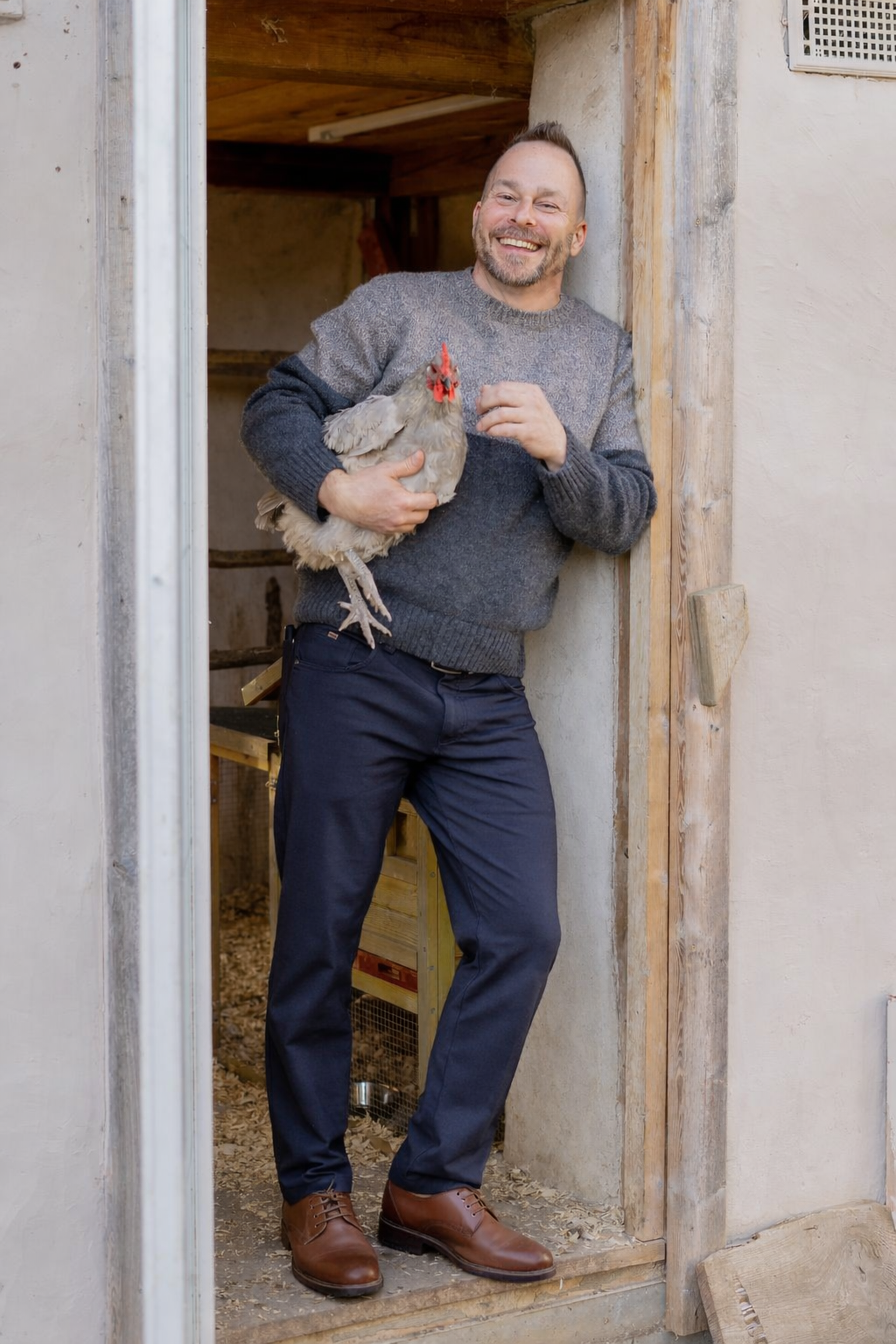
It started simply enough. We got day-old Ameraucana chicks in the middle of May. We borrowed a temporary coop from our neighbours, but we knew we needed something more permanent. My wife Janna had plans for a modest little wooden coop. Sensible. Practical. Completely adequate.
I wanted to go bigger. Go grander. Go straw bale.
Both buildings already on our property — the studio and the house — are straw bale construction, so it only made sense the coop would be too. We also have three vacation rental suites, and guests are constantly fascinated by the construction method. I figured this build would be the perfect opportunity to document the whole process and share it. So — here we go. Chapter 1.
We picked up our five baby Ameraucana chicks from Performance Poultry, just down the road from us. We chose this breed specifically because Ameraucanas lay eggs with pale green and blue shells — yes, really. Beyond the novelty factor, they're beautiful, hardy birds that do well in cold climates like ours. A perfect fit for Prince Edward County winters.
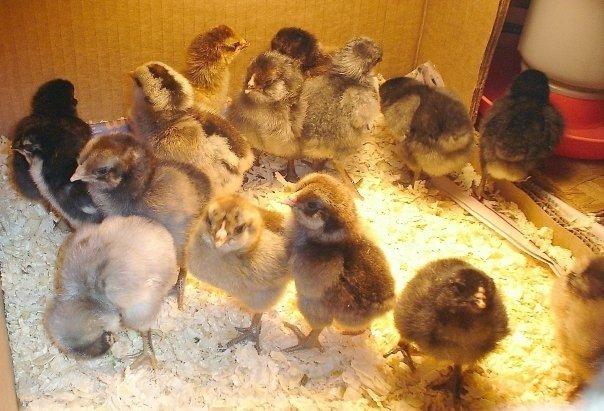
Our five Ameraucana chicks — they grow up fast. Those pale green and blue eggs were worth every penny of the $6,000 coop.
- Straw bale walls achieve an insulation value of roughly R-30 to R-50 — significantly higher than standard wood-framed construction. That means warm in winter, cool in summer, and lower energy bills.
- Compressed bales are surprisingly fire-resistant. Unlike loose straw, tightly packed bales have very little oxygen for combustion — they smoulder rather than burn, and clay plaster adds another layer of protection.
- Straw is a carbon-sequestering material. The carbon the plant absorbed while growing stays locked in the wall for the life of the building. It doesn't get much more eco-friendly than that.
- Straw bale construction has roots in North America going back to the 1880s in Nebraska, where settlers used what was available. What started out of necessity turned out to be one of the most thermally efficient building methods around.
- The clay and lime plaster finish is completely natural and breathable, which means walls can regulate moisture without trapping it — a key reason straw bale buildings last for generations when properly built.
The first step in any construction project is figuring out what you can actually build without a permit. In our area of Prince Edward County, a structure under 10'×10' doesn't require one — so that's exactly what we planned for.
The next question was interior space. Straw bale walls are thick — standard small bales run 18" deep, 14" high, and 36" long. After stacking and applying two coats of clay and lime plaster, the walls end up about 20" thick. That means our 10'×10' exterior footprint gives us roughly a 7'×7' interior — which is actually a comfortable amount of space for a backyard flock.
Plenty of room. Time to build.
This is the most critical part of any straw bale build: you must keep the bales completely dry, from the day they're delivered to the day the building comes down decades later. Moisture is the only real enemy of a straw bale wall. A good foundation solves this.
We needed a raised concrete slab — elevated enough that no groundwater or rain splash could ever reach the base of the bales. The first step was bringing in a load of gravel to lay over the undisturbed ground beneath the building site.
"The truck got stuck delivering our gravel, so we had to wheelbarrow it to the building site. It was quite the make-work project. We also had to bring in another dump truck of dirt to repair the deep ruts — and after finally planting and growing grass around our house, we found ourselves once again surrounded by mud."
After finally getting the gravel in place, we rented a plate tamper to compact it, then built the form for the concrete slab. One key detail we made sure not to skip: setting anchor bolts directly in the wet concrete so we could later attach the sill plate to a solid footing. No shortcuts on the base.
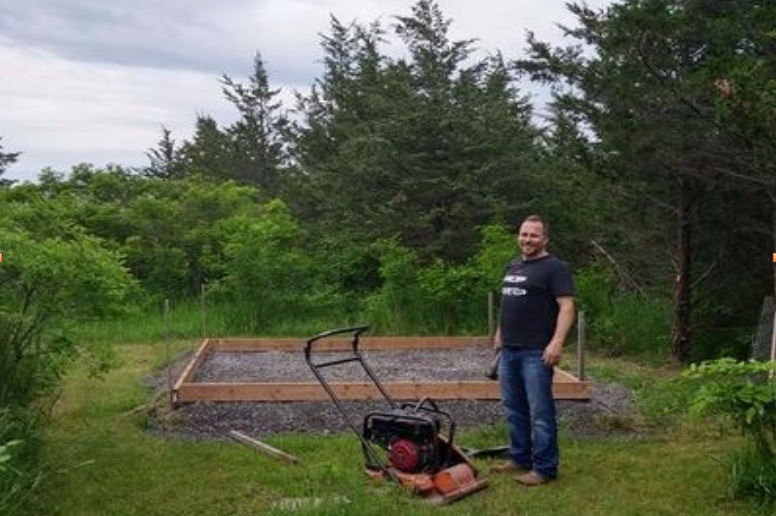
The gravel compacted, the form built, anchor bolts ready to go. All that wheelbarrowing paid off.
Here's where my inner ironworker came out. I've had a dream for years to build a barn-style workshop on the property — and I figured this coop was the perfect place to test the concept. So we went with a post and beam frame using a gambrel roof — that classic barn silhouette. Bigger than a chicken coop probably needs to be? Absolutely. Did I care? Not at all.
In a post and beam straw bale build, the structural frame carries the load — the bales are infill, not load-bearing. The posts are set in about 20" from the perimeter, which is exactly where the bale courses will sit once the frame is up. This approach gives you the flexibility to raise the roof and frame the structure without worrying about the bales at all — they come later.
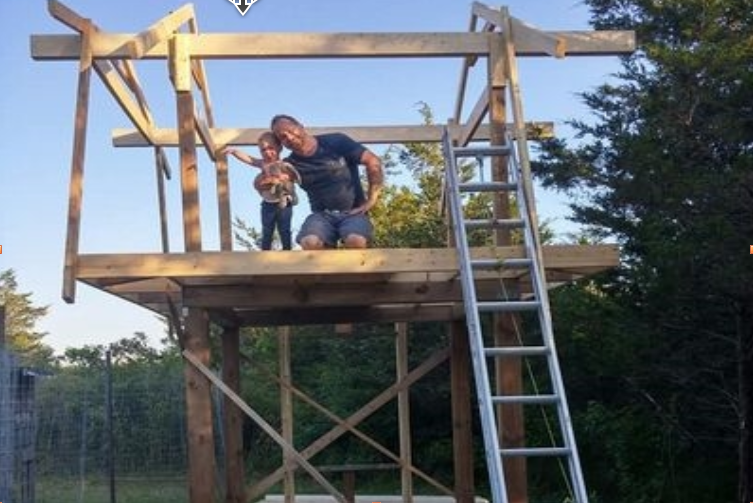
That's Zoe up there with me — about a year and a half old and already fearless on the ladder.
Our little Zoe — who was about a year and a half at the time — was the unofficial site supervisor. Before I became a realtor, I spent 15 years as a Journeyman Ironworker with Toronto Local 721. Working at heights was just part of the job. Zoe, apparently, inherited this completely. If we turned our backs for a second she was already halfway up the ladder.
For the roof, we chose metal sheeting over the gambrel framing. Metal roofs last a very long time, hold up to the county's winters, and — maybe most importantly — they're ideal for rainwater collection, which fits perfectly with how we try to run the homestead.
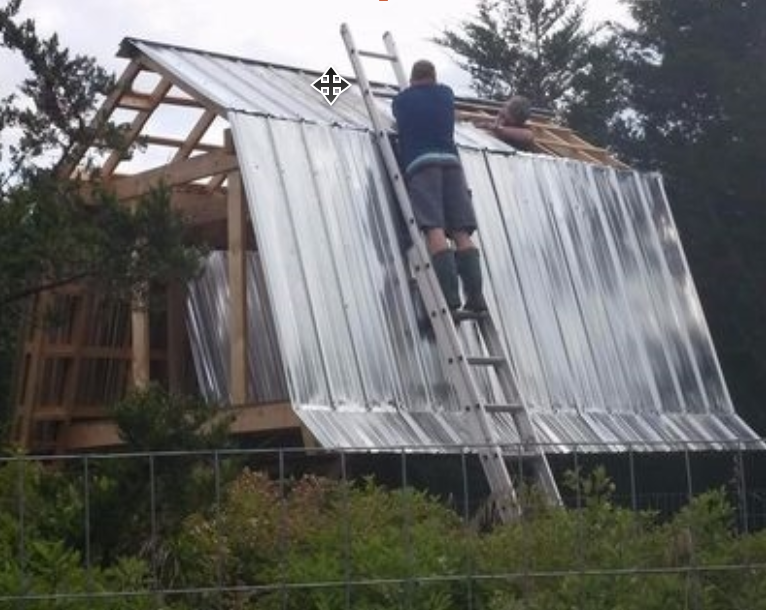
Getting the metal panels up on the gambrel frame. Heights don't bother a former ironworker — nor, apparently, his toddler.
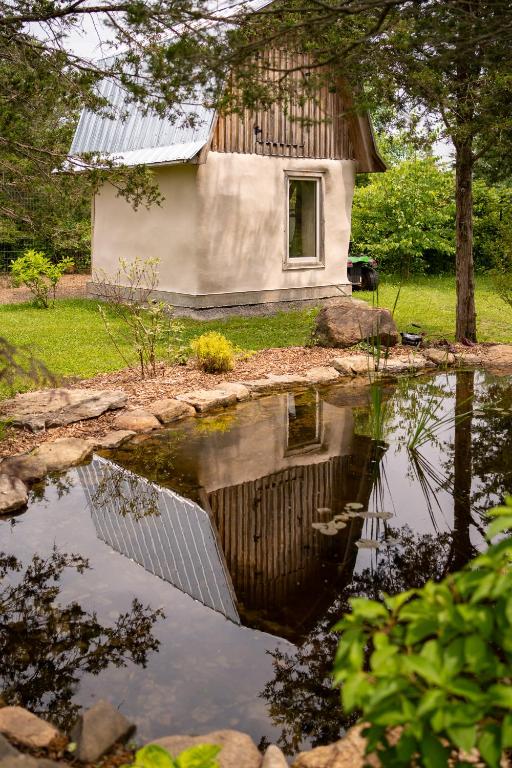
The finished product — lime plaster walls, metal gambrel roof, and a pond reflection we didn't plan but will absolutely take credit for.
Here's something most people don't know: Prince Edward County is where Ontario's straw bale story began. In 1998, builder and natural building pioneer Chris Magwood completed the province's first permitted straw bale home right here in the County. That wasn't a fluke — PEC has been a hub for natural building, permaculture, and eco-homesteading ever since. There are now more than 300 permitted straw bale buildings across Ontario, and a disproportionate number of the early ones are right here in this region.
There are a few reasons PEC is particularly well-suited for this type of construction:
- The climate is a perfect fit. Straw bale walls achieve R-30 to R-40 insulation values — dramatically higher than standard 2×6 stick-frame construction. In a county with cold winters, freeze-thaw cycles, and rising energy costs, that's not just a green choice, it's a smart financial one.
- Rural zoning supports it. PEC's rural bylaws explicitly permit owner-built structures on larger lots, making alternative construction a natural fit for hobby farms, homesteads, and lifestyle properties across the county.
- There's a clear permitting pathway. Ontario Building Code Appendix BJ provides a documented process for getting straw bale construction approved — this isn't an experimental loophole, it's an established code pathway that local building officials are increasingly familiar with.
- It costs less than you'd think. Straw bale construction in Ontario typically comes in about 5% below equivalent conventional stick-frame builds — and that's before you factor in lifetime energy savings from superior insulation.
- The community is here. Builders like Aerecura Sustainable Builders work in Eastern Ontario, and organizations like the Ontario Natural Building Coalition offer workshops, resources, and connections for anyone curious about building this way.
If you've been thinking about building a home in Prince Edward County — whether a full primary residence or a rural retreat — and you're curious about natural building methods, I'd genuinely love to talk. Between living in a straw bale home, building outbuildings this way, and knowing the land and zoning landscape of the County inside and out, I have connections and first-hand experience that can help you get started the right way. Reach out any time.

The County market, once a month — no noise.
CLAR MLS data, honest analysis, and what it means for buyers and sellers in Prince Edward County. One email a month.
- Sales volume, prices & days on market — straight from CLAR
- What's moving and what's sitting — and why
- Homestead life, area guides, and investment insights across PEC
No spam. Unsubscribe any time.